
Almost everyone has thousands of photographs and almost nobody prints them. The gap between a phone gallery and something on a wall is mostly a matter of not knowing which images will survive being enlarged, which format suits which picture, and how big a piece a given wall actually needs. This guide answers those questions practically, whether the print is for a home, a gift, or a workplace.
Start with the image, not the product
The most common disappointment with a printed photograph is that the file was never good enough, and no printing process rescues that. Two checks settle it in a minute.
Check the pixel dimensions, not the file size in megabytes. In your phone or computer’s file information, look for something like “4032 × 3024”. Divide each number by the printing resolution to get the maximum sensible print size. At 150 dpi — comfortable for wall art viewed from a metre or more — 4032 pixels divides to about 27 inches, roughly 68 cm. At 300 dpi, for something viewed close up, it halves to about 34 cm.
View at 100% on a screen and look at the detail in the eyes, or in foliage, or in fabric texture. If it looks soft, blocky or smeared at that magnification, it will look worse printed. Screenshots, images saved from social media and pictures forwarded through messaging apps are all heavily compressed and are the usual culprits.
Some honest realities: a photo taken in low light with a phone will show noise when enlarged; a heavily zoomed shot is a crop and has fewer real pixels than the camera’s specification suggests; and an image that has been through a messaging app several times has lost detail permanently. None of that means the picture is worthless — it means printing it smaller will look far better than printing it large.
Which format suits which photograph
Canvas softens fine detail and adds texture, which flatters portraits, landscapes and anything with a painterly quality. It has no glass, so no glare, and it works in awkwardly lit rooms. It is the most forgiving format for a file that is not enormous. It is the wrong choice for images that depend on razor-sharp detail or on very deep blacks.
Photo paper, framed under glass gives the sharpest result and the deepest blacks. Best for architectural shots, sharp portraits, high-detail work and black and white. The trade-off is glare, so consider the room’s lighting before committing, and consider non-reflective glazing for a wall opposite a window.
Acrylic (photo behind clear acrylic) produces the most vivid, saturated result of any format, with a sense of depth. Excellent for bold colour and modern interiors. It is the most expensive option and it does reflect.
Aluminium / dibond gives a contemporary, frameless, very durable panel. Good for high-contrast graphic images and for humid rooms where canvas or paper would suffer.
Foam board and lightweight panels are inexpensive and fine for temporary display, but they dent easily and are not a long-term wall piece.
Linen-weave canvas deserves a specific mention for portraiture and family images. The irregular weave reads as texture rather than as substrate, and it makes an ordinary photograph feel like a considered object. Studios that offer Fotodrobės ant lino alongside standard cotton canvas will usually send both as samples, and seeing the two side by side settles the choice immediately.
Sizing: the mistake is almost always going too small
People consistently underestimate how large a piece a wall needs, and the result is a print that looks apologetic.
Working guidelines:
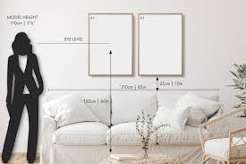
- Above a sofa or bed: the piece (or the group) should span roughly two-thirds of the furniture’s width. For a 200 cm sofa, that means about 130 cm of art.
- On an empty wall: aim for the art to occupy 55-75% of the usable wall width.
- Hanging height: the centre of the piece at 145-150 cm from the floor. Centring on the wall usually places art too high; centring on eye level almost always looks right.
- Above furniture: leave 15-25 cm between the top of the furniture and the bottom of the frame, so the two read as related.
- Groups: 5-8 cm between pieces, and treat the whole group as one rectangle when sizing it.
A cheap and effective test: cut newspaper or kraft paper to the candidate size, tape it on the wall, and live with it for a day. It costs nothing and it prevents the most expensive mistake in the process.
Crop and orientation
Phone photographs are usually 4:3 or 3:2, and common print formats are not. Something has to give.
Decide the crop deliberately rather than letting an ordering system do it automatically — automatic cropping cuts from the centre and routinely removes the top of someone’s head. When ordering, use the preview to confirm the crop, and if a gallery wrap is involved, remember that the wrap consumes several centimetres from every edge on top of the crop.
On orientation: landscape images suit wide walls above furniture; portrait images suit narrow wall segments and spaces between windows; square works well in groups and in modern interiors. A panoramic crop from a wide landscape can be extremely effective above a bed or a sofa, and it often uses a file more efficiently than forcing the same image into a standard rectangle.
Black and white, and other decisions worth making
Converting to black and white is not a rescue for a bad photograph, but it is genuinely the right choice more often than people try it. It removes the distraction of mixed colour casts — very common in indoor family shots under mixed lighting — and it makes a group of otherwise mismatched photographs work together as a wall. For a gallery wall assembled from images taken years apart on different cameras, converting everything to black and white is the single most effective unifying decision.
Two other decisions worth making deliberately: whether to include a border (a white margin around the image gives a classic, gallery feel and makes a small image feel more considered), and whether the piece should be coated. A protective coat on canvas allows gentle cleaning and adds UV resistance, and on any piece that will hang in a bright room it meaningfully extends the life of the colours.
Photographs as gifts
A printed photograph is one of the few gifts that is genuinely personal and genuinely useful, and there are a few things that make the difference between a good one and an awkward one.
Choose an image the recipient is in, or one from a moment they remember, rather than a technically better photograph they have no connection to. Emotional relevance beats sharpness every time in this context.
Be careful about size in someone else’s home — a large canvas is a commitment they may not want to make on your behalf. Something in the 30-50 cm range is a gift; something 120 cm wide is a decorating decision.
Allow real lead time. Production plus delivery around holidays is longer than the quoted turnaround, and a rushed order is where crop errors happen.
For a group gift, a multi-piece set from one event — three images from a wedding, a trip or a milestone — works better than one large print, because it tells a sequence rather than freezing one frame.
Before you order: a short checklist
- Pixel dimensions checked and matched to the intended size.
- Image viewed at 100% and judged honestly for sharpness and noise.
- Format chosen for the image and the room’s lighting, not just on price.
- Size tested on the wall with paper.
- Crop confirmed in the preview, with wrap allowance accounted for.
- Original file sent, not a version forwarded through a messaging app.
- A small proof ordered first if the piece is large, expensive or a gift.
That last point is worth more than the rest combined on any significant piece. A 20 × 30 cm test print costs very little and answers every question about colour, sharpness and crop at once. Most printing studios will produce one on request, and it converts an uncertain order into a confident one.
Care once it is on the wall
Keep any print out of direct sunlight — pigment inks are lightfast for decades in normal indoor light, but nothing survives a sunbeam indefinitely. Avoid bathrooms and condensation-prone walls for canvas, which is fabric and absorbs moisture. Dust with a dry microfibre cloth; wipe only if the piece is coated. And if a canvas slackens in humid weather, the small wooden wedges in the stretcher corners can be tapped gently to re-tension it.
Summary
- Check pixel dimensions and view at 100% before choosing a size — nothing rescues a weak file.
- Canvas forgives and flatters; paper under glass is sharpest; acrylic is most vivid; aluminium is most durable.
- Two-thirds of the furniture width, centre at 145-150 cm, and test the size with paper on the wall first.
- Control the crop yourself and allow for gallery-wrap loss.
- Black and white unifies mismatched images into a coherent wall.
- For gifts, prioritise emotional relevance and modest size, and order a proof.