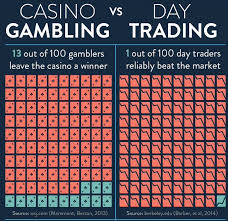

Investing and games of chance both involve uncertain outcomes. That surface similarity can make them look alike. Their underlying mechanics, however, differ in important ways.
An investor may buy an asset without knowing its future price. A game of chance can also produce an unknown result. In both cases, probability matters, and neither outcome comes with a guarantee.
The difference lies in what creates the uncertainty.
Investments represent assets such as shares in businesses or debt issued by companies and governments. Their value can change with profits, interest rates, economic conditions, and market demand. Investors can study these factors and spread exposure across many assets.
Games of chance use rules that define possible outcomes and their probabilities. The participant cannot change those underlying probabilities through research into a company or economy.
This distinction becomes clearer through three ideas: risk, probability, and expected return.
Risk asks what could be lost. Probability measures how likely different outcomes are. Expected return estimates the average result that a process may produce over many observations.
Understanding these concepts helps separate two activities that both involve uncertainty but operate in very different ways.
Probability Describes Risk But Does Not Remove It
Probability measures how likely an outcome is. It does not tell us what will happen next.
A company may have strong sales and rising profits, yet its share price can still fall. Interest rates may change. Costs may rise. New competitors may enter the market. Investors work with probabilities because the future remains uncertain.
Games of chance also use probability, but the source of uncertainty differs. A phrase such as desi online slots india may appear in discussions of digital chance-based games, where software rules define a set of possible outcomes.
Investments do not usually work within such fixed boundaries.
A business can grow, shrink, create new products, take on debt, or enter new markets. Its future value depends on many changing factors. Investors can study those factors, but they cannot remove uncertainty.
This is why probability is a tool, not a prediction.
It helps people compare possible outcomes and judge risk. It cannot guarantee which outcome will occur next.
Expected Return Measures The Average Outcome Over Time
Expected return gives uncertainty a numerical frame.
It does not predict the result of one investment. Instead, it estimates the average outcome that might emerge across many possible scenarios.
Suppose an asset has several possible future values. Analysts can estimate each outcome, assign a probability, and combine those figures into an expected return. The result acts like a weighted average.
Investing adds another layer.
A company can earn revenue, produce cash flow, pay dividends, and reinvest profits. These economic activities can create value over time. Investors therefore examine business performance alongside price and risk.
In a game of chance, the expected outcome comes from the rules and probability structure of the game. Repeating the same event does not create an underlying productive asset.
This difference matters.
Two activities can both involve uncertain results while having very different sources of potential return.
Expected return describes the average mathematical outcome, while the source of that return explains what kind of risk a person is taking.
Diversification Changes How Investment Risk Works
Investment risk does not have to depend on one outcome.
An investor can spread money across different assets, industries, or regions. This practice is called diversification. Its purpose is to reduce the damage that one weak investment can cause to the whole portfolio.
Imagine carrying ten eggs.
Putting every egg in one basket creates a clear risk. If the basket falls, everything breaks. Dividing the eggs among several baskets does not remove danger, but one accident causes less damage.
Diversification works on a similar principle.
If one company performs poorly, gains elsewhere may offset part of the loss. Investors can also combine assets that respond differently to economic changes.
This does not guarantee a profit. A broad market decline can affect many investments at once.
Still, diversification changes the structure of risk. It reduces dependence on one company, one sector, or one event.
That is a key feature of investing: some risks can be measured, spread, and managed even though uncertainty remains.
Time Changes The Meaning Of Investment Risk
Time plays a major role in investing.
An asset can rise or fall sharply over a week. Over longer periods, its value may reflect changes in profits, cash flow, interest rates, and the wider economy.
This creates a key distinction between short-term volatility and long-term return.
A falling price does not always mean the underlying asset has permanently lost value. In the same way, a rising price does not prove that an investment is sound.
Investors therefore examine more than the latest result.
They can study financial statements, debt, valuation, market conditions, and the quality of the asset itself. New information can also change their view over time.
Games of chance have a different structure. Waiting longer does not turn a fixed chance-based event into a productive asset.
Time can give an investment room to create economic value, but it cannot remove risk.
That is why the time horizon matters when investors compare possible returns and losses.
Research Can Change An Investment Decision
Investors can gather new information before committing capital.
They can study revenue, profit, debt, cash flow, competition, and valuation. None of these figures reveals the future, but each can improve the quality of a decision.
Suppose two companies sell similar products.
One earns steady profits and carries little debt. The other loses money and depends on expensive borrowing. Their share prices may still move in unexpected ways, but the underlying financial risks are not identical.
Research helps reveal that difference.
It also gives investors a reason to change course. If a company’s finances weaken, an investor can reassess the original idea. If conditions improve, the estimated value may change as well.
This does not make investing predictable.
It means that new evidence can alter the assessment of risk and potential return.
That feature separates investment analysis from systems where fixed rules determine the probability structure of each event.
Productive Assets Can Create Value Beyond Price Changes
Many investments connect capital to an underlying productive asset.
A company can sell products, earn revenue, hire workers, and develop new technology. A bond can fund business activity or public projects while producing interest payments under its terms.
This gives investors more than a changing market price to examine.
They can ask whether a business earns money, whether its debt looks manageable, and whether demand for its products is growing. These factors may affect the asset’s long-term value.
Games of chance do not create the same economic link. Their outcomes come from a defined probability system rather than the future productivity of an owned asset.
This distinction does not make every investment profitable.
Companies fail. Bonds can default. Assets can become overpriced. Investors can lose money even after careful research.
The key difference is structural: an investment may generate value through economic activity, while an uncertain outcome alone does not create a productive asset.
Understanding that difference helps explain why risk should never be judged by price movement alone.
Risk And Expected Return Must Be Read Together
Return alone tells only half the story.
Two investments may offer similar potential gains while exposing investors to very different levels of risk. One may have stable cash flows and modest price changes. Another may depend on uncertain growth and move sharply in either direction.
This is why investors compare potential return with the risk required to pursue it.
A simple analogy is choosing between two bridges. Both reach the same destination. One is wide and solid. The other is narrow and damaged. The destination may be identical, but the journey is not.
Financial analysis follows the same logic.
Investors examine volatility, debt, liquidity, business strength, and possible losses. They also consider whether the potential return provides enough compensation for those risks.
Games of chance have a different structure. Their probabilities and payouts define the mathematical relationship between risk and possible outcomes.
A possible return means little without understanding the risk attached to it.
Good financial analysis therefore asks two questions together: what could be gained, and what could be lost?
The Difference Lies In Where Returns Come From
Investing and games of chance can both produce gains or losses. That does not make their economic structure the same.
With investing, potential returns can come from productive activity. A company may sell more goods, improve margins, expand into new markets, or distribute part of its profit to shareholders.
Market prices can still move for many other reasons. Yet investors have an underlying asset whose financial condition can be studied.
Games of chance use a different model. Possible outcomes and payouts follow rules set within the game. There is no business asset growing behind each individual result.
This difference explains why probability alone cannot define an investment.
Investors also need to understand what creates value, what could destroy it, and how much they are paying for that potential.
Uncertainty exists in both settings, but its source matters.
Investing links risk to assets and economic activity. Games of chance link uncertainty to defined outcomes and probability rules.
Understanding The Source Of Risk Changes The Comparison
Investing and games of chance both contain uncertainty, but the source of risk differs.
Investment risk can come from falling sales, high debt, inflation, interest-rate changes, competition, or poor management. These forces can change over time. Investors can study them and adjust their assumptions as new information appears.
Games of chance usually place uncertainty inside a predefined system. Rules establish possible outcomes and how those outcomes are produced.
That distinction affects expected returns.
An investment may gain value because the underlying asset becomes more productive. It may also lose value when the original assumptions prove wrong. Research cannot guarantee success, but it can help explain why the risk exists.
This is the central difference.
Uncertainty alone does not make investing and games of chance equivalent. What matters is where potential returns come from, whether an underlying asset can create value, and which risks can be analyzed or managed.
Understanding those features gives investors a clearer framework for judging financial decisions without confusing risk with pure chance.